
Over the last year and a half, you have probably heard a concept that comes up repeatedly in economic discussions on radio and television: "safe-haven assets." Sounds familiar, right? Safe-haven assets are financial assets that are considered safe and stable in times of economic or political uncertainty. They are a way to protect investments from market volatility and reduce the risk of loss. In times of uncertainty, investors seek refuge in these assets, causing their value to increase. That is why they are considered a form of defensive investment.
Real Estate: Stable, tangible, profitable, and attractive
Real estate is a great safe haven due to its stability and ability to maintain its value in times of economic uncertainty, such as those we are currently experiencing. This is due to several factors. First, real estate is usually an asset that maintains its value over the long term. Although housing prices may fluctuate in the short term due to economic or market factors, in the long term the trend is usually positive and prices tend to rise. In addition, they offer a stream of income, either through rentals or subsequent sale at a price higher than the purchase price, which can provide an additional and stable source of income in the case of rentals. This makes them ideal for investors seeking long-term stability and security.
In addition, real estate is a tangible investment, which means that investors have a physical asset that they can see and touch. This makes it safer than financial investments, as it is a tangible way to protect your wealth and reduce your dependence on financial markets, which can be more volatile and uncertain. It is also a way to diversify investments, meaning that investors do not have all their eggs in one basket. This reduces the risk of loss and provides long-term stability. In the case of Spain, it is also attractive to foreign investors thanks to programs such as the Golden Visa, explained in detail in this post, which allows them to obtain temporary or permanent residence in Spain. Fifthly, during periods of inflation, such as the one we are currently experiencing, real estate prices tend to rise along with the prices of other goods and services, which helps to maintain the purchasing power of wealth. This is different from financial assets, such as stocks or bonds, which can be negatively affected by inflation.
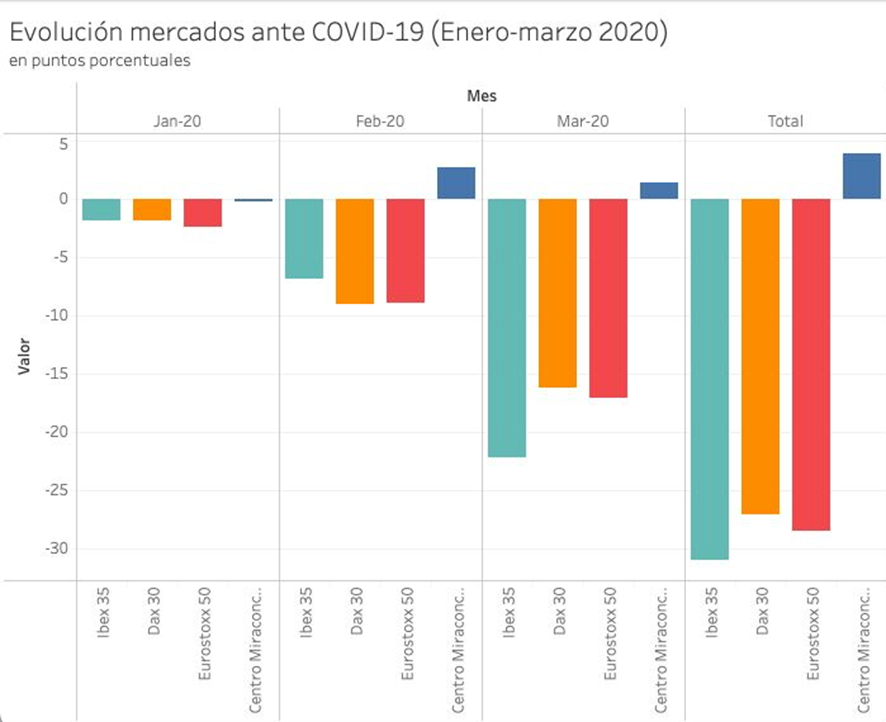
But since a picture is worth a thousand words, we want to show you that real estate is a safe bet with concrete data and in a visual way. The two graphs accompanying this article show the evolution of the main markets in the face of two recent contexts of international uncertainty: the COVID-19 pandemic and the war in Ukraine. In both cases, we have also added the evolution of real estate assets in our area of operation: San Sebastián, and more specifically in the Centro and Miraconcha areas. In the first of these, we see the reaction of the markets to the COVID pandemic from the time it broke out in China in January 2020 until it spread to Europe in March 2020. The various stock market indices began a steady and progressive decline from the moment the first news arrived until a state of emergency was declared in Spain. At that point, the Spanish benchmark index, the IBEX-35, had fallen by more than 20%. In contrast, real estate prices in Centro-Miraconcha fell slightly in January but rebounded quickly in February and March, becoming the only asset to appreciate in value in that context of panic and uncertainty.
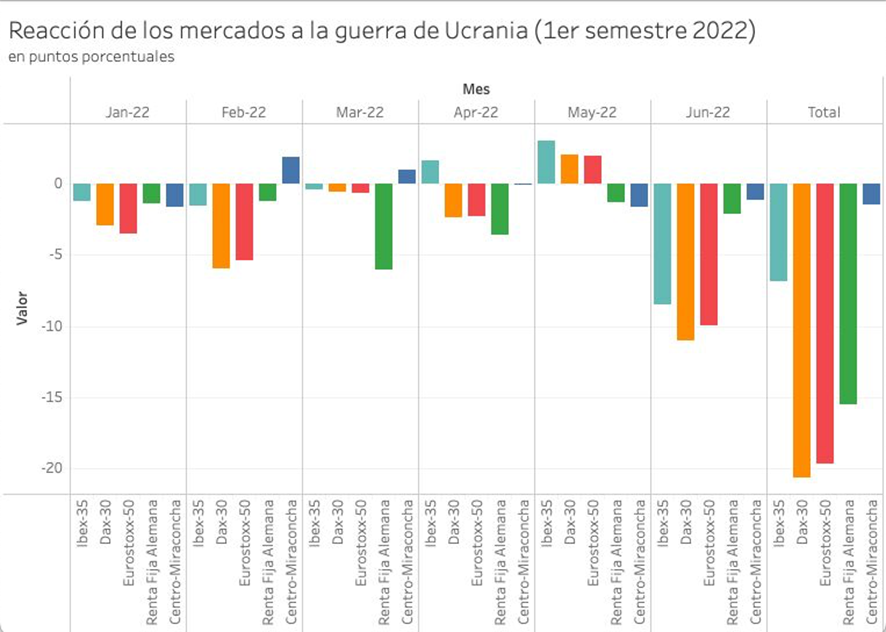
Let's now analyze a new graph, two years later. The echoes of the pandemic are still being felt, although there is another focus of international concern: the Russian invasion and subsequent war in Ukraine in the first half of 2022. It doesn't matter whether we analyze it month by month or as a whole. While real estate remains stable with ups and downs of 1-2%, the financial markets are affected month by month by the ups and downs of the war, suffering slight rises and sharp falls without maintaining any stability throughout the period. As can be seen in the last column, real estate fell by 1% over the entire period, while some indices, such as the German Dax-30, suffered losses of more than 20%.
In summary, real estate can be a safe haven for investors seeking to protect their wealth and maintain their purchasing power, especially during periods of inflation and economic uncertainty. It is a way to not only make money, but also avoid losing it.
Other safe-haven assets
In addition to real estate, there are a number of assets that have traditionally been considered safe havens. One of these is gold. It has been considered a safe haven for centuries due to its long-term stability and ability to maintain its value in times of economic uncertainty, when its price tends to rise due to investor demand. Another popular safe haven is Treasury bonds issued by governments. These bonds are often considered safe due to their government guarantee and long-term stability. Investors seek out these bonds as a way to protect their investments from market volatility and reduce the risk of loss. The dollar can also be considered a safe haven due to its stability and role as a global reserve currency. Take, for example, the 2002 Argentine corralito crisis, when the peso-dollar parity caused millions of people to flock to banks to withdraw cash dollars, leading to the financial collapse of the state.
Whether it's gold, dollars, treasury bonds, or real estate investments, at Reditas we advise our investors to always diversify their assets. After all, it is the best way to protect your wealth. And to do so, any of the securities we have seen here are perfectly valid. From there, our expertise lies in real estate, and more specifically in San Sebastián, an excellent place to invest, whether you are looking for profitability or seeking to protect your wealth.
Our team's goal is to acquire real estate, renovate it, and sell it, thereby generating attractive short-term returns. We add value to real estate properties in the exclusive neighborhoods of San Sebastián.
Tax advisor and real estate investment consultant. He has driven and led Reditas since its inception: identifying opportunities, structuring transactions, and maintaining direct relationships with investors and partners. With in-depth knowledge of the San Sebastián market, he is involved in every project, ensuring sound judgment, oversight, and execution.
Bachelor of Business Administration from the University of the Basque Country.

Responsible for the execution of real estate projects. He has a proven track record in construction and renovation, ensuring that deadlines, budgets, and quality standards are met on every project.
He holds a degree in Industrial Engineering from the Polytechnic University of Catalonia and an MBA from ESADE.
Working closely with senior management, he oversees the proper functioning of the management company across various areas, including communications, finance, sales, and others. He maintains direct contact with investors, financial institutions, the various construction companies with which we collaborate on construction projects, and the real estate firms that market our assets. Drawing on his legal expertise, he advises on and participates in the preparation and review of the company’s legal documentation.
Bachelor of Laws from Pompeu Fabra University.

With over 20 years of experience, he specializes in designing investment solutions for high-net-worth clients. At Reditas, he builds relationships with investors based on trust, transparency, and a long-term vision.
He holds a degree in Telecommunications Engineering from the UOC and is a certified financial advisor and wealth manager from the FEF School, Spanish Institute of Analysts.

Responsible for on-site technical execution, he coordinates teams and oversees every phase of the project to ensure quality, efficiency, and control throughout the renovation process.
He holds a degree in Public Works and Civil Engineering from the Polytechnic University of Catalonia.

She combines a keen eye for design with a practical and strategic approach. She plays anactive role in defining and developing projects, optimizing each space to maximize its value and functionality.
She holds a degree in Architecture from the University of the Basque Country.

She brings a strategic perspective to design, grounded in consumer behavior. Her work goes beyond aesthetics, focusing each space on making an impact and facilitating the purchasing decision.
, Certified Marketing and Advertising Specialist from CEBANC.

Responsible for developing Reditas's narrative. She works on creating content that clearly and accessibly conveys the value of each project, building trust with investors through transparency.
She holds a degree in Journalism from Ramón Llull University.


 630 463 324
